
Walsh–Hadamard codes of length \(N = 2^k\) are the rows of the Sylvester Hadamard matrix. Mapped to \(\pm 1\) they are mutually orthogonal. The listing builds that matrix, checks the Gram matrix, and plots the periodic cross-correlation of the first row against the others.
Python
import numpy as np
import matplotlib.pyplot as plt

def hadamard(n):
    H = np.array([[0, 0], [0, 1]], dtype=int)
    while H.shape[0] < n:
        H = np.block([[H, H], [H, 1 - H]])
    return H

N = 8
H = hadamard(N)
pm = 1 - 2 * H.astype(float)
print("G =\n", (pm @ pm.T).astype(int))

lags = np.arange(-(N - 1), N)
ref = pm[0]
for r in range(1, N):
    corr = np.array([np.dot(ref, np.roll(pm[r], k)) for k in range(-(N - 1), N)])
    plt.plot(lags, corr, label="row %d" % r)
plt.xlabel("lag")
plt.ylabel("periodic correlation")
plt.title("Cross-correlation of Walsh row 0 with rows 1..7")
plt.grid(True, alpha=0.3)
plt.legend(fontsize=8)
plt.tight_layout()
plt.show()

# Autocorrelation of one row: strong only at lag 0 for this alphabet length.
acf = np.array([np.dot(pm[1], np.roll(pm[1], k)) for k in lags])
print("acf of row 1 at lag 0, +/-1:", acf[N - 1], acf[N], acf[N - 2])
Matlab
The original Matlab helper is unchanged in spirit. bitand(codeSize,codeSize-1)==0 still enforces a power of two. Invert the bottom-right quadrant at each doubling, exactly as in the Sylvester step above.
function H = generateHadamardMatrix(codeSize)
N = 2;
H = [0 0; 0 1];
if bitand(codeSize, codeSize-1) ~= 0
    error('codeSize must be a power of 2');
end
while N ~= codeSize
    N = N * 2;
    H = repmat(H, [2 2]);
    H(N/2+1:N, N/2+1:N) = ~H(N/2+1:N, N/2+1:N);
end
end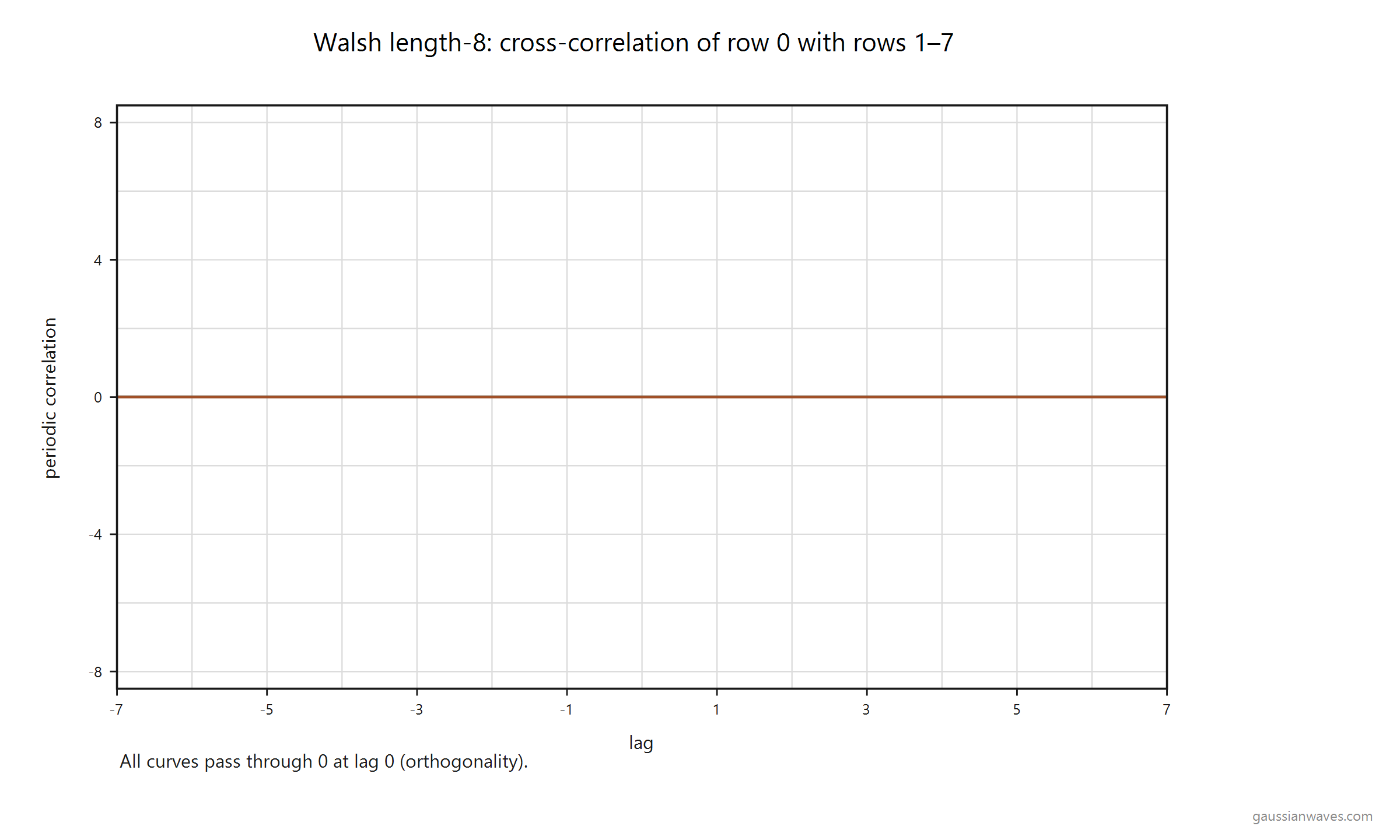

See also
[1] Codes used in CDMA
[2] Spread Spectrum Communications – Intro