Malus law says how much polarized light gets through two polarizing filters. For single particles of light it becomes a probability, which is the first step toward quantum randomness. This post builds the idea from an everyday analogy, a formula, and a short simulation. No quantum physics background is needed.
Why we start with Malus law
This blog is about communication systems, so why quantum topics? One of the most practical quantum ideas is quantum key distribution. It is a communication protocol: it sends bits over a channel, the channel adds errors, and an eavesdropper leaves traces. The protocol that does this is called BB84, and we build up to it in this series.
To understand BB84 you need three things:
- A physical carrier of quantum bits. Polarized photons are one common choice.
- A rule that turns physics into probabilities. That is the Born rule.
- Measuring in a chosen direction. The result depends on that choice.
Malus law gives all three, starting from light you already know. That is why it is the first post. Each later post adds one new idea on top of it.
Learning path: Quantum basics for engineers
This is post 1 of a six-part series. Read in order:
- Malus’s law and polarization (this post): the angle rule, and its probability version.
- Qubits and the Bloch sphere: the quantum state as a point on a sphere.
- Measurement and basis choice: what happens when you measure in a different direction.
- Quantum bit error rate: errors on a quantum channel.
- The BB84 protocol: the complete key-exchange recipe.
- BB84 simulation with an eavesdropper.
An analogy: a picket fence for waves
Tie a rope to a post and shake the free end up and down. The wave runs along the rope. Now put a fence with vertical slats in its path. The up-and-down wave passes through the gaps. Shake the rope side to side, and the slats block it.
A polarizing filter works like that fence for light. Light is a wave whose electric field wiggles back and forth in one direction. That direction is the light’s polarization. A polarizer is a filter with slats that lets through the part of the wiggle lined up with them and blocks the rest.
Two filters and an angle
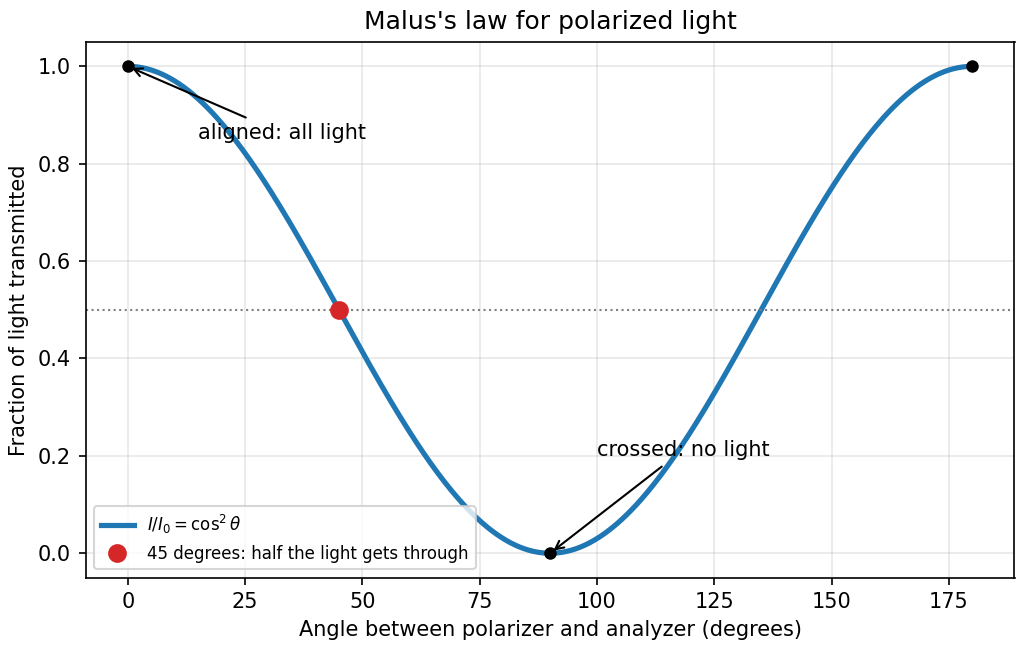
Place two polarizers in a row. The first one sets the light’s polarization, and we call its slat direction 0 degrees. Turn the second polarizer by an angle $\theta$, and ask how much light gets through.
Malus’s law gives the answer:
$$I = I_0 \cos^2\theta$$
Here $I_0$ is the light leaving the first polarizer, and $I$ is the light leaving the second. The formula has two parts:
- The cosine. Picture a ruler held at an angle $\theta$ to a table, with a lamp directly overhead. Its shadow on the table has length equal to the ruler’s length times $\cos\theta$. Flat on the table ($\theta = 0$), the shadow is the full length. Standing upright ($\theta = 90$ degrees), the shadow is gone. The cosine plays the same role for light: it measures how much of the electric field lines up with the second polarizer.
- The square. Light brightness, or intensity, is proportional to the square of the electric field. So the cosine gets squared.
Some values to remember:
| Angle $\theta$ | Fraction of light through, $\cos^2\theta$ |
|---|---|
| 0 degrees | 1 (all of it) |
| 30 degrees | 0.75 |
| 45 degrees | 0.5 (half) |
| 60 degrees | 0.25 |
| 90 degrees | 0 (crossed polarizers block everything) |
From light to single photons
Light is made of photons, tiny packets of energy. Dim a light source enough and you can count photons one at a time. Each photon that reaches the second polarizer either passes or is absorbed. It cannot pass partly.
So for one photon the outcome is yes or no. But Malus’s law still predicts what happens over many photons. Read it as a probability, the chance that a single photon passes:
$$P(\text{pass}) = \cos^2\theta$$
This is the Born rule in its simplest form. The rule says that the probability of an outcome is the square of a number, here the cosine. The Born rule is the central rule of quantum mechanics, and it returns in every later post in this series.
The key point is that you can’t predict which photon will pass. You can only predict the fraction. It works like a biased coin: you can’t say what the next flip will be, but over many flips the fraction heads comes close to the bias.
One more detail matters later. A photon that passes the second polarizer now points along its slats. The filter changed the photon’s polarization. Measurement can change the thing being measured.
A simulation with photons
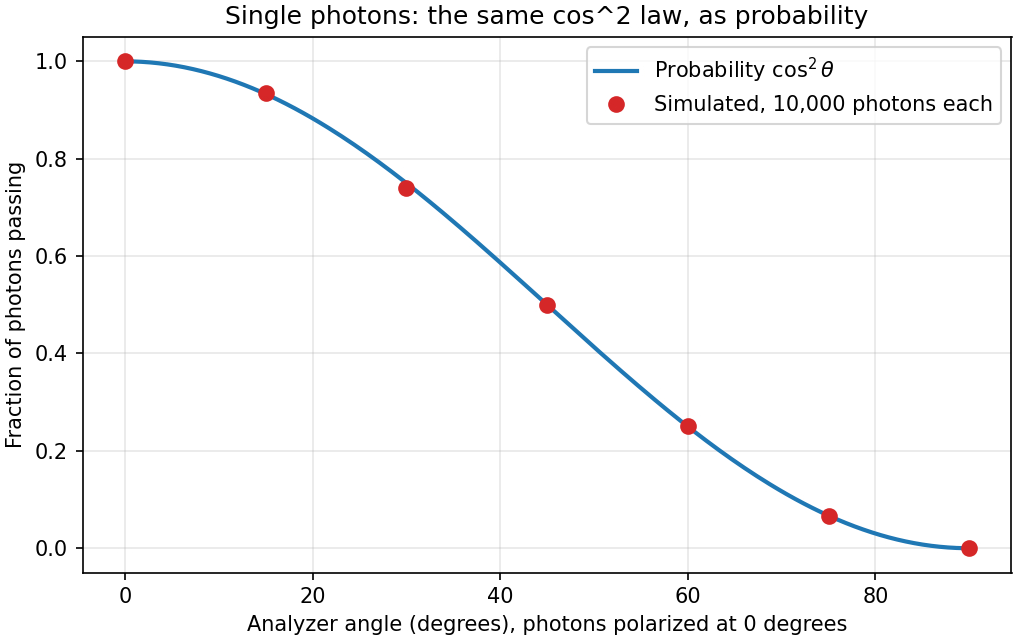
The code below sends 10,000 photons through the second polarizer at each angle. Each photon is polarized at 0 degrees. Its chance of passing is $\cos^2\theta$. A random number decides whether it passes.
import numpy as np

def pass_probability(photon_angle_deg, analyzer_angle_deg):
    """Probability a single photon passes an analyzer (Malus's law as a probability)."""
    delta = np.deg2rad(analyzer_angle_deg - photon_angle_deg)
    return np.cos(delta) ** 2

rng = np.random.default_rng(7)
n_photons = 10_000
photon_angle = 0.0                    # every photon is polarized at 0 degrees

for theta in [0, 15, 30, 45, 60, 75, 90]:
    p = pass_probability(photon_angle, theta)
    passed = rng.random(n_photons) < p    # each photon passes with probability p
print(f"{theta:3d} deg: theory {p:.3f}, simulated {passed.mean():.3f}")Running it prints:
  0 deg: theory 1.000, simulated 1.000
 15 deg: theory 0.933, simulated 0.935
 30 deg: theory 0.750, simulated 0.739
 45 deg: theory 0.500, simulated 0.500
 60 deg: theory 0.250, simulated 0.251
 75 deg: theory 0.067, simulated 0.067
90 deg: theory 0.000, simulated 0.000The simulated fractions match the formula to within about 0.01. The small differences come from random chance, and they shrink as you increase the number of photons.
What comes next
The probability $\cos^2\theta$ is the seed of the whole series. In the next post we replace the photon’s polarization angle with a qubit, a quantum state that holds more than yes or no. We will show it as a point on a sphere, the Bloch sphere, and the same cos² rule will appear again.
Summary
- Polarized light passing through a polarizer follows Malus’s law, $I = I_0 \cos^2\theta$.
- For single photons, the same formula gives the probability of passing.
- The outcome of one photon is random, but the fraction over many photons is predictable.
- Measurement can change the state of the thing measured.
Learning path: Quantum basics for engineers
- Malus law and polarization
- Qubits and the Bloch sphere
- Measurement and basis choice
- Quantum bit error rate
- The BB84 protocol
- BB84 simulation with an eavesdropper
References
Further reading:
- Malus’s law (Wikipedia): the formula and its history.
- Polarization (Wikipedia) and Polarizer (Wikipedia): the physics of the filters used here.
- Photon (Wikipedia): what a photon is.
- Born rule (Wikipedia): the probability rule used in this post.
- Quantum measurement (Stanford Encyclopedia of Philosophy): a deeper, more technical treatment of measurement, for later posts.
- BB84 (Wikipedia): the protocol this series builds toward.
Classical communication math behind this series. The probability and error-rate ideas here are the same ones used in digital communications. The GaussianWaves eBooks cover that classical side with runnable Python and Matlab code.