
5G NR PHY path:
OFDM basics →
Resource block (PRB) →
Bandwidth part (BWP) →
π/2-BPSK in NR →
OFDM overhead calculator
In one sentence: a 5G NR physical resource block (PRB) is the scheduler’s atomic chunk of spectrum — 12 consecutive subcarriers — whose Hertz width scales with numerology: $latex 12\times\Delta f$ (180 kHz at 15 kHz SCS, 360 kHz at 30 kHz, …).
People searching for “5G resource block” or “physical resource block in 5G” usually want that definition, how it sits in the frame/slot grid, and how PRB bandwidth changes with $latex \mu$. This page answers those first.
Where the PRB sits in the NR stack
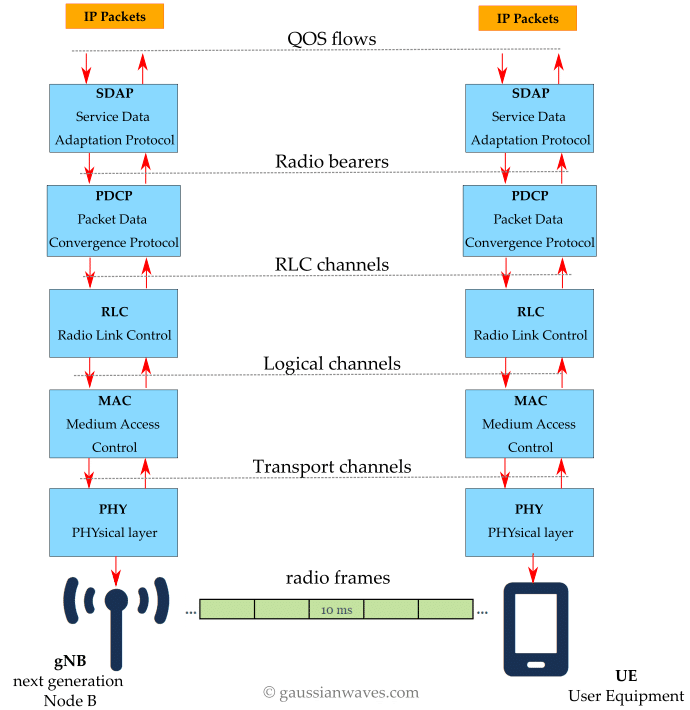
On the air interface between gNB and UE, the PHY carries radio frames. Above PHY, the user-plane stack (MAC → RLC → PDCP → SDAP) delivers user data; the control plane sets up the connection and mobility. Figure 1 recalls the user-plane view — the resource grid lives at the PHY edge of that picture.
Radio frame, subframe, slot
In time, NR uses a fixed 10 ms radio frame of ten 1 ms subframes. Each subframe holds one or more slots; each slot (normal cyclic prefix) holds 14 OFDM symbols. A mini-slot is a transmission using fewer than 14 symbols inside a slot. Figure 2 shows how the number of slots per subframe grows with numerology $latex \mu$.

Because OFDM symbol duration shrinks as subcarrier spacing $latex \Delta f$ grows, slot duration scales as $latex 1\,\mathrm{ms}/2^{\mu}$. Table 1 lists the supported transmission numerologies (3GPP TS 38.211).

Resource element, resource block, resource grid
A resource element (RE) is one subcarrier on one OFDM symbol — the smallest time–frequency atom. It is indexed as $latex (k,l)_{p,\mu}$ where $latex k$ is the subcarrier index, $latex l$ the symbol index in the slot, $latex p$ the antenna port, and $latex \mu$ the numerology.
A physical resource block (PRB) is 12 consecutive subcarriers in frequency. That is the unit the scheduler assigns. It is not “an OFDM symbol with 12 tones” — a single OFDM symbol spans the whole active bandwidth (many PRBs); the PRB is a frequency slice across those symbols.
The resource grid for a carrier/BWP is $latex N^{\mathrm{size},\mu}_{\mathrm{grid},x}$ subcarriers by $latex N^{\mathrm{subframe},\mu}_{\mathrm{symb}}$ OFDM symbols per subframe (Tables 2–3 for normal vs extended CP).


PRB bandwidth vs numerology
With $latex N^{\mathrm{RB}}_{\mathrm{sc}}=12$ fixed, PRB bandwidth is simply
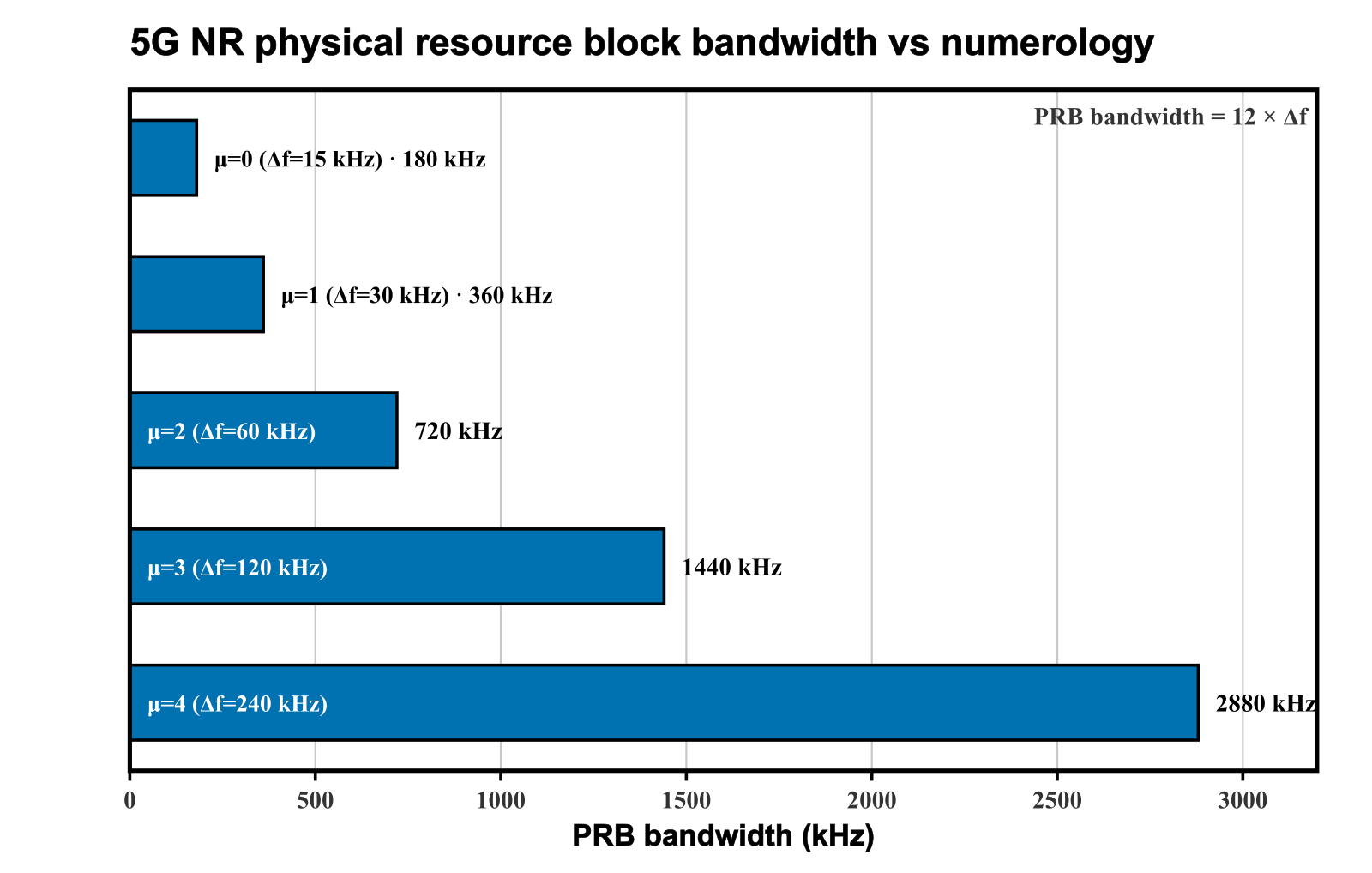
\[B_{\mathrm{PRB}}(\mu) = 12\,\Delta f(\mu) = 12\cdot 15\cdot 2^{\mu}\;\mathrm{kHz}\]So $latex \mu=0\Rightarrow 180\,\mathrm{kHz}$, $latex \mu=1\Rightarrow 360\,\mathrm{kHz}$, $latex \mu=2\Rightarrow 720\,\mathrm{kHz}$, $latex \mu=3\Rightarrow 1.44\,\mathrm{MHz}$, $latex \mu=4\Rightarrow 2.88\,\mathrm{MHz}$. Figure 4 plots those widths.
Python: PRB bandwidth table
import pandas as pd

def prb_bandwidth_khz(mu: int) -> float:
    """B_PRB = 12 * 15 * 2^mu  (kHz), 3GPP TS 38.211."""
    return 12 * 15 * (2 ** mu)

rows = []
for mu in range(5):
    scs = 15 * (2 ** mu)
    rows.append({
        "mu": mu,
        "SCS (kHz)": scs,
        "PRB bandwidth (kHz)": prb_bandwidth_khz(mu),
        "slots / subframe": 2 ** mu,
        "slot duration (ms)": 1 / (2 ** mu),
    })
print(pd.DataFrame(rows).to_string(index=False))
Cross-check CP/overhead on a full carrier with the OFDM overhead calculator. For how a UE’s active PRB set is carved from the carrier, continue to Bandwidth Part (BWP) in 5G NR.
FAQ
What is a 5G NR resource block (PRB)? In NR, a physical resource block is 12 consecutive subcarriers in frequency for one slot in time (with the slot duration set by the numerology $latex \mu$). It is the basic scheduling quantum the gNB allocates to a UE — not a single OFDM symbol and not an arbitrary Hertz bandwidth.
How does subcarrier spacing change the PRB bandwidth? Subcarrier spacing is $latex 15\cdot 2^{\mu}
FAQ
Is a resource block the same as a slot? No. A PRB is a frequency unit (12 subcarriers). A slot is a time unit (14 OFDM symbols for normal CP). Schedulers usually grant a set of PRBs over one or more slots.
Why do people say “12 × 14”? Over one slot with normal CP you have 12 subcarriers × 14 symbols = 168 resource elements per PRB per slot (before DM-RS and other overhead). The PRB definition itself is still the 12-subcarrier strip.
Does PRB bandwidth change inside a BWP? Not by itself — $latex B_{\mathrm{PRB}}$ follows the BWP’s numerology. Changing $latex \mu$ (or switching BWP) changes both SCS and PRB width.
nbsp;kHz, so one PRB spans $latex 12\times 15\cdot 2^{\mu}FAQ
Is a resource block the same as a slot? No. A PRB is a frequency unit (12 subcarriers). A slot is a time unit (14 OFDM symbols for normal CP). Schedulers usually grant a set of PRBs over one or more slots.
Why do people say “12 × 14”? Over one slot with normal CP you have 12 subcarriers × 14 symbols = 168 resource elements per PRB per slot (before DM-RS and other overhead). The PRB definition itself is still the 12-subcarrier strip.
Does PRB bandwidth change inside a BWP? Not by itself — $latex B_{\mathrm{PRB}}$ follows the BWP’s numerology. Changing $latex \mu$ (or switching BWP) changes both SCS and PRB width.
nbsp;kHz (180 kHz at $latex \mu=0$, 360 kHz at $latex \mu=1$, and so on). Higher numerologies buy shorter symbols and wider PRBs for the same 12-subcarrier definition.Where does this show up in link-budget or PHY work? Transport-block sizing, reference-signal density, and occupied bandwidth all scale with the number of scheduled PRBs and the numerology. Pair this article with the OFDM overhead and BER tools when you move from resource grids to rates and error performance.
References
[1] 3GPP TS 38.211, NR; Physical channels and modulation — resource grid, numerology, and PRB definition.
For Table 2 and Table 3, I believe the caption must read “slots per subframe” instead of “subframes per slot”
Thanks for pointing it out. It is now corrected.
Hi, do not understand concept of data mapping onto subcarriers. Suppose simple scenario. We schedule PDSCH on some slot. As one RB is smallest allocation for UE, then will UE read 168 (14x12sc) or just 14(1sc) OFDM symbols of PDSCH data (suppose that we do nat have DMRS for PDSCH)? I guess the first case is valid, we still talk about TDD.
In 5G NR, a resource block (RB) is defined only for the frequency domain. i.e, a RB is a block of 12 subcarriers. We can assume that the minimum length of resource block is 1 OFDM symbol.
The exact Resource allocation for UE for PDSCH in time domain is defined by Start and Length Indicator Value (SLIV) or directly using the indicators : start symbol S and the allocation length L. Refer: ETSI TS 138 214 V17.3.0 (2022-09) section 5.1.2.1.