
Antenna models — reading order
- Maxwell’s equations
- Retarded potentials
- Near-field / far-field boundary
- Far-field retarded potentials
- Array pattern multiplication (this article)
- Dipole power gain patterns
Introduction
Take one element’s radiation vector \(\mathbf{F}\), place \(N\) identical copies at positions \(\mathbf{l}_i\) with weights \(a_i\), and the far-field total factors as \(\mathbf{F}\,A\). That is pattern multiplication: the step from a single dipole to an array.
Motive
Can we predict an array pattern without re-solving Maxwell’s equations for every geometry? Yes—if we have a short formula that matches a polar plot. That is what we set up here.
Technical development
\[\mathbf{F}_{\mathrm{total}}(\mathbf{k})=\mathbf{F}(\mathbf{k})\sum_{i=0}^{N-1}a_i e^{j\mathbf{k}\cdot\mathbf{l}_i}=\mathbf{F}(\mathbf{k})\,A(\mathbf{k}).\]The sum is the array factor. Indices run \(0\ldots N-1\); the phase uses the dot product \(\mathbf{k}\cdot\mathbf{l}_i\), not a bare juxtaposition of vectors.
How this achieves the motive
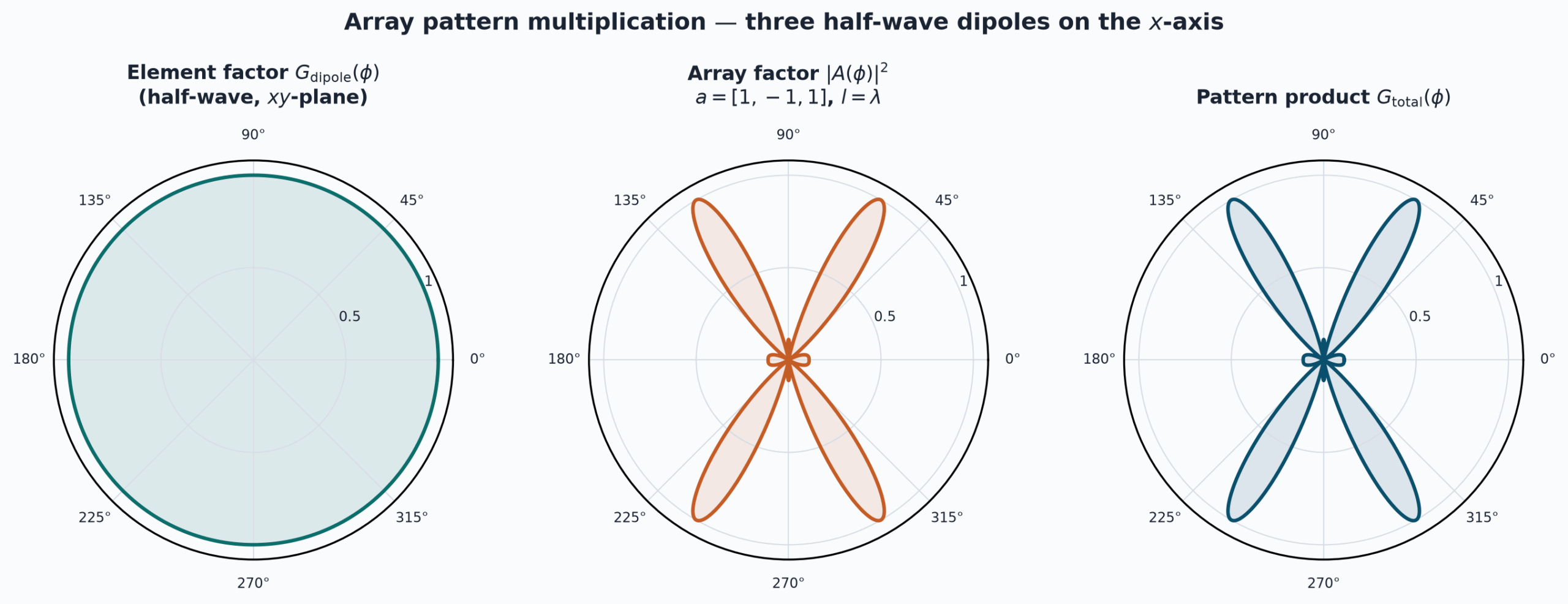
Figure 4 is what you should get: three polar panels from the listing. Peaks of the product sit where the array factor peaks, scaled by the element factor.
Sample simulation
import numpy as np
import matplotlib.pyplot as plt

def array_factor(phi, a, l_over_lambda):
    kdl = 2 * np.pi * l_over_lambda
    af = np.zeros_like(phi, dtype=complex)
    for i, ai in enumerate(a):
        af += ai * np.exp(1j * i * kdl * np.cos(phi))
    return af

phi = np.linspace(0, 2*np.pi, 1441)
a = np.array([1.0, -1.0, 1.0])
AF = array_factor(phi, a, 1.0)
G_el = np.ones_like(phi)
G_af = np.abs(AF)**2; G_af /= np.max(G_af)
G_tot = G_af * G_el; G_tot /= np.max(G_tot)
fig, axes = plt.subplots(1, 3, subplot_kw=dict(projection="polar"), figsize=(12, 4))
for ax, g, title in zip(axes, [G_el, G_af, G_tot], ["Element", "|A|^2", "Product"]):
    ax.plot(phi, g); ax.set_ylim(0, 1.08); ax.set_title(title)
plt.show()
Sample results
You should recover the four-lobe AF of Figure 4. For more on scanning and grating lobes with this same AF kernel, see the phased-array series.
Next topic
Specialise the element to wires you can plot: dipole power-gain patterns.
References
[1] Orfanidis. [2] Balanis. [3] Mailloux.