Power delay profile (PDP) — multipath power vs delay
What a power delay profile is, how it shows multipath taps vs excess delay, and how it connects to delay spread and wireless channel models.

Signal Processing for Communication Systems
What a power delay profile is, how it shows multipath taps vs excess delay, and how it connects to delay spread and wireless channel models.
Multipath & PDP (same on every page in this path) 1. Power delay profile → 2. Scattering function (you are here) → 3. TDL modeling Tools: PDP demo · 3GPP TDL Understand various characteristics of a wireless channel through multipath channel models. Discuss Wide Sense Stationary channel, uncorrelated scattering channel, wide sense stationary uncorrelated scattering … Read more
BLUE / Gauss–Markov: the best linear unbiased estimator is weighted least squares when noise covariance is known — intuition and formula.
Key focus: Understand step by step, the least squares estimator for parameter estimation. Hands-on example to fit a curve using least squares estimation Background: The various estimation concepts/techniques like Maximum Likelihood Estimation (MLE), Minimum Variance Unbiased Estimation (MVUE), Best Linear Unbiased Estimator (BLUE) – all falling under the umbrella of classical estimation – require assumptions/knowledge … Read more
The agenda for the subsequent series of articles is to introduce the idea of autocorrelation, AutoCorrelation Function (ACF), Partial AutoCorrelation Function (PACF) , using ACF and PACF in system identification. Introduction Given time series data (stock market data, sunspot numbers over a period of years, signal samples received over a communication channel etc.,), successive values … Read more
If a time series data is assumed to be following an Auto-Regressive (\(AR(N)\)) model of given form, the natural tendency is to estimate the model parameters \(a_1,a_2, \cdots, a_N\). Least squares method can be applied here to estimate the model parameters but the computations become cumbersome as the order \(N\) increases. Fortunately, the AR model … Read more
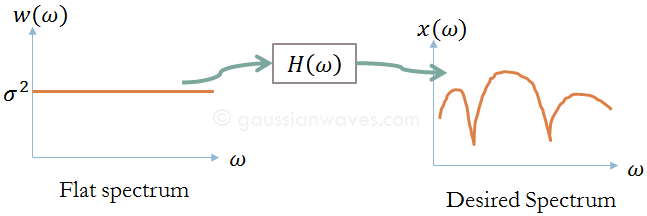
Key focus: “Why can’t I just use a matrix to solve ARMA?” The answer is right there in the shape of the surface—you can’t solve a “warped” landscape with a linear equation. Introduction In signal modeling, our goal is to find a set of coefficients (ak and bk) that best describe an observed signal. We … Read more
Key focus: AR, MA & ARMA models express the nature of transfer function of LTI system. Understand the basic idea behind those models & know their frequency responses. How do you describe a complex, random signal—like the sound of a human voice or the fluctuating power of a fading channel—using only a few numbers? The … Read more
Key focus: Applying Cramér-Rao Lower Bound (CRLB) for vector parameter estimation. Know about covariance matrix, Fisher information matrix & CRLB matrix.
Non-central chi-squared distribution: PDF with non-centrality parameter λ, relation to Rician power / energy detection, and Matlab/Python sampling examples.