Volterra series RF power amplifier model — memory, nonlinearity, and 5G bandwidth

RF nonlinearity path: Volterra PA model → π/2-BPSK PAPR → EVM → SNR In one sentence: A Volterra series extends a Taylor polynomial with memory taps so you can model RF power amplifiers whose present output depends on recent past inputs — the regime of wideband 4G/5G waveforms.  Key focus: Volterra series is an … Read more

Array pattern multiplication of phased array antennas

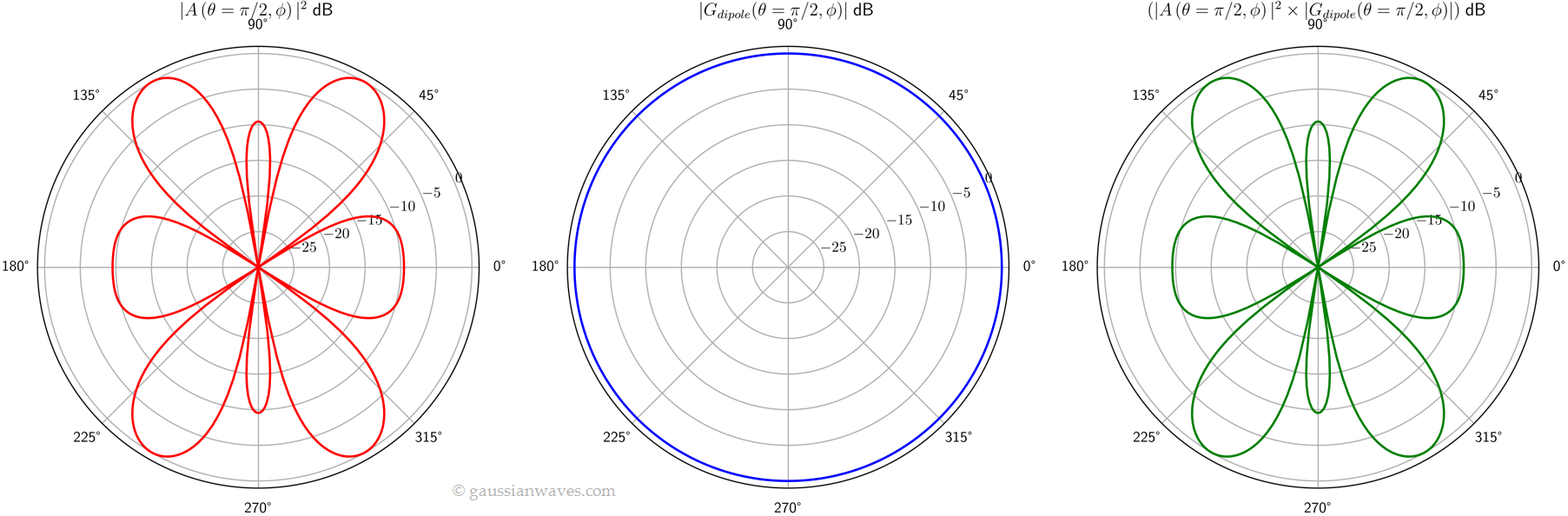
Antenna models — reading order Maxwell’s equations Retarded potentials Near-field / far-field boundary Far-field retarded potentials Array pattern multiplication (this article) Dipole power gain patterns Introduction Take one element’s radiation vector \(\mathbf{F}\), place \(N\) identical copies at positions \(\mathbf{l}_i\) with weights \(a_i\), and the far-field total factors as \(\mathbf{F}\,A\). That is pattern multiplication: the step … Read more

Far-field retarded potentials

Antenna models — reading order Maxwell’s equations Retarded potentials Near-field / far-field boundary Far-field retarded potentials (this article) Array pattern multiplication Dipole power gain patterns Introduction In the Fraunhofer region the amplitude goes as \(1/r\), and the phase is \(e^{-jkr}\) times a linearised path through the source. The angular part factors into a radiation vector … Read more

Near-field – far-field : Where is the boundary ?

Antenna models — reading order Maxwell’s equations Retarded potentials Near-field / far-field boundary (this article) Far-field retarded potentials Array pattern multiplication Dipole power gain patterns Introduction Antenna fields change character with distance: reactive storage near the element, Fresnel diffraction at intermediate range, and spherical-wave radiation farther out. Link-budget and pattern formulas almost always assume that … Read more

From Maxwell’s equations to antenna array – part 1

Antenna models — reading order Maxwell’s equations (this article) Retarded potentials Near-field / far-field boundary Far-field retarded potentials Array pattern multiplication Dipole power gain patterns Introduction Antenna theory is Maxwell’s equations plus boundary conditions and a far-field approximation. Before retarded potentials and array factors, write the four laws carefully—especially Ampère’s law with Maxwell’s displacement current. … Read more

Normalized power gain of dipole antennas

Antenna models — reading order Maxwell’s equations Retarded potentials Near-field / far-field boundary Far-field retarded potentials Array pattern multiplication Dipole power gain patterns (this article) Introduction You have almost certainly seen the short-dipole pattern: nulls along the wire, maximum broadside. We will derive the normalised power patterns for the Hertzian dipole, the half-wave dipole, and … Read more

Bayes’ theorem

Key focus: Bayes’ theorem is a method for revising the prior probability for specific event, taking into account the evidence available about the event. Introduction In statistics, the process of drawing conclusions from data subject to random variations – is called “statistical inference”. Usually, in any random experiment, the observations are recorded and conclusions have … Read more